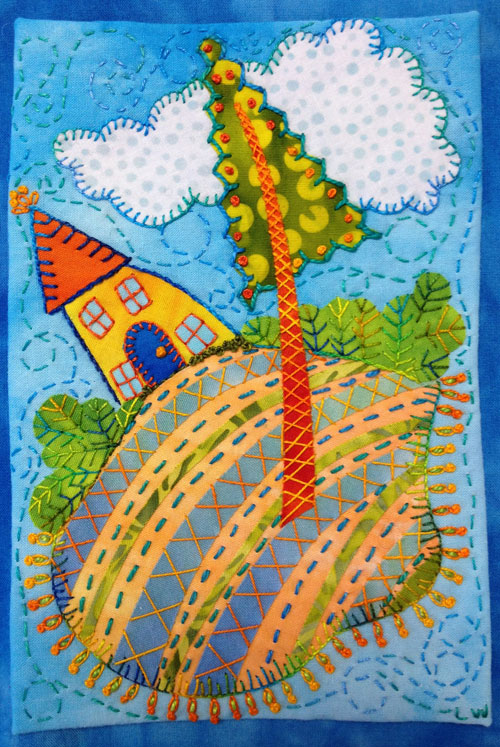
One little embroidery stitch can take your quilt from flat to fabulous! Simple stitches will add line, color, texture and those wonderful details you can’t get with fabric alone.
Tips for adding hand stitches to your fused art quilts:
- Needle Size Information: Use the appropriate size embroidery needle for the size of thread you are using. Use a size 5 needle for Size 12 pearl cotton thread, a size 3 or 4 needle for Size 8 thread, and a size 1 needle for Size 5 or 3 thread.
- Thread Size Information: Size 12 pearl cotton thread is the finest and easiest to stitch through several layers of fused fabrics. Size 8 is the most utilitarian thread for fused art quilts. It is bold enough to be seen but easy to stitch. Size 5 is heavier, a little more difficult to stitch with but gives a bolder look. Size 3 is very heavy, difficult to hand stitch with but is perfect for couching. See this size comparison chart for the different pearl cotton threads.
- Cut the thread about 18″ long, any longer and it tangles easily.
- Stitch just through the top and batting layers of the quilt. When all the stitching is complete, add the quilt back and machine stitch through all the layers if you want.
- Knot or embed the threads in the batting.
- To mark a stitch line, score the fabric with the tip of the needle or a fingernail.
- Wear a thimble to protect fingers.
- Begin with the focal point of the composition and then work on other areas of the quilt. If you stitch intensely in an unimportant part of the composition, it will take a lot of stitching to draw the viewers eye back to the focal point. It is important that stitching in other areas of the quilt not become so intense that they detract from the focal point.
The Ten Commandments of Stitching a Fused Art Quilt
1. Thou shalt not kill thy glue! We are working with a heat activated glue. If you expose it to too much heat from an iron for too long it makes the fabric really stiff and burns the glue into the fabric. It also makes it difficult to hand stitch. When constructing your quilt top just fuse-tack the design elements for a few seconds to hold the shapes into place.
2. Thou shalt steam thy glue! Fabric with fusible web must be steam set for 10 seconds to make it permanent and to make it easier to stitch through.
3. Thou shalt use batting that is easy to stitch through! Some batts are so dense you can barely get an embroidery needle through them. Test the batting first before applying your quilt to the batt. I like Hobbs Premium 80/20, wool batting, or Fairfield’s Cotton Classic. Make sure the batting doesn’t beard with stitching.
4. Thou shalt fused thy quilt to the non-scrim side of the batting! Fusing to the scrim side of the batt may ripple the quilt and no amount of stitching will fix it.
5. Thou shalt not have too many layers of fused fabric! My dainty little fingers can only stitch through 3 layers of fused fabrics. Anything more and I make sure I don’t have a lot of stitches to add in that area.
6. Thou shalt use a thimble! Its that added layer of protection that keeps your dainty little fingers happy and safe.
7. Thou shalt use a needle that is appropriate for thy thread! See the embroidery needle chart to match your thread with your needle. Then test out various brands. For instance, I discovered that the Size 4 Richard Hemmings Needles work better on my Size 8 thread than a size 3 needle.
8. Thou shalt stitch only through the top layers of the fabric! There is no need to make every stitch go entirely through the batting and top layers. Just skim the needle and thread under the fabric to create your stitches.
9. Thou shalt have good lighting so thou shalt not go blind and stab thyself! You need to see what you’re doing.
10. Thou shalt relax and enjoy thyself! I can not stress this enough. Relax and enjoy the process. It will change your art.
Running Stitch
You too can get in the groove. Line up Running Stitches, curl them around, make them short, or long. There are endless possibilities for the lowly Running Stitch. Try it today!
French Knots
Here’s how to make a French Knots: Grasp the thread in your left hand and hold it parallel to the fabric. Wind the thread clockwise around the horizontal needle 3 times.
Holding the wound thread in place, scoot the tip of the needle just next to where the thread initially emerged from the fabric. (Don’t pull the thread too tight around the needle.) Poke the needle into the fabric and slowly draw the thread through the knot to the back. The trick here is to continue to gently grip the thread in your left hand so the thread doesn’t tangle as its drawn through the knot.
Here’s a tip: if the thread slips off the needle before you can insert it into the fabric: use the fingernail on your right hand to hold the wound thread into place.
French Knots are the perfect stitch for adding a hit of color, to build texture, or to add an accent mark you can not make with fabric. Use them for flowers, doorknobs, or rows of cabbages.
Straight Stitch
Hand embroiderers who work on art quilts are constantly inventing stitchery to accommodate the images they are embellishing. Need window panes? Tree bark? Grass? The Straight Stitch covers these needs and acts as a stroke mark to help define the shapes. Here you can see the stitch as branches on the tree, window panes, and roof tiles.
Here’s how I make the Straight Stitch: with the thread on top of the quilt, point the needle in the right direction and stick it down drawing the thread along with it. Straight Stitches can be in any direction and evenly spaced (or not). Just don’t make them too long or the thread may bag and snag.
Nothing worse than bagging and snagging.
Scattered Seed Stitch
The Scattered Seed Stitch is my version of the traditional seed stitch (where sets of short parallel stitches travel across the fabric). Being an undisciplined stitcher, I just throw individual stitches all over the place. It’s more akin to the Straight Stitch (see above) but I like the name, “Scattered Seed Stitch”. Use it for filling in large areas of fabric to create texture.
Here’s how to make the Scattered Seed Stitch: Make a straight stitch about 1/4 – 1/2 inch long. Repeat making more straight stitches near the previous stitch but at a different angles. Think of the stitch angles in terms of an hour hand on a clock. Try to keep it random and not to have the stitches form a pattern by repeating stitch angles near each other.
Pistil Stitch
The Pistil Stitch has me hooked and now I must use it on everything! It’s a relative of the French Knot only taller and sassier. Making a Pistil Stitch is very similar to making a French Knot except you extend where you return the needle.
Here’s how I make the Pistil Stitch: Hold the thread horizontal to the fabric and wind it around the needle 3 times. Select a point about 1/4″ – 1/2″ away from where the thread came up out of the fabric. Insert the needle into the fabric and slowly draw the thread through the knot while still holding the thread gently in your left hand.
Pistil Stitches are not only for….pistils. I use them for little bird necklaces and head dresses as well. This is a detail from Coleen’s Calling Birds #13 made with hand-dyed silk and stitched with Size 12 threads. Doesn’t she look fetching?
Fly Stitch
Stem or Outline Stitch
Here’s how to make Blanket Stitches: With the thread on top at A, place the tip of the needle about 1/4″ up and to the right of point A. Insert the needle at B and exit at C, about 1/4″ to the right of A. Trap the thread coming out of A under the needle tip and draw the needle and thread slowly through the fabric.
Point C is now Point A. Repeat the directions above forming a row or following the edge of a shape. Different effects are achieved by varying the spacing between points A and C or the length of the B/C stitch. Here’s an example of the Blanket Stitch as an outtie rather than an innie.
Here’s how to make Cross Stitches: First make a straight stitch in any direction from A to B. Then cross over that stitch at a right angle by bringing the thread up at C and returning at point D. As you repeat these directions, it may be helpful to think of the stitch as a letter X.
Whether you line them up like tin soldiers or scatter them around like jacks on the playground, Cross Stitches make fun patterns and texture on the fabric.
Here’s how to make Sheaf Stitches: Make 3 vertical stitches measuring about 1/4″ long and spaced about 1/16″ apart. Bring the needle up to the surface of the fabric at Point A (which is the center of the middle stitch). Slip the needle and thread under the left vertical stitch. Insert the needle tip under the right vertical stitch and jab it back down at Point A. Pull the thread gently to form a cinched group of threads.
If you line them up, Sheaf Stitches act as an orderly band of decorative motif racing across the fabric surface. These concentrated deposits of thread are bundles of joy!
Couching
Lets say you’re a bird and you need stripped legs.You don’t want to spend a lot of time making your skinny legs with fabric. So what the solution? Couching.
Couching is a method of securing thick threads to the surface of fabric by lying a heavy thread down and stitching over it with a smaller, easier to handle thread. You can make shapely legs, outline a shape, create lines, or add heavy duty texture to your quilt tops all with this easy stitch.
Here’s how to add Couching to your quilt top: Using a Size 1 embroidery needle, bring a Size 3 pearl cotton thread to the top of the fabric where you want the line to begin. Then bring a needle threaded with a thin thread (Size 8 or Size 12) to the top of the fabric about 1/8″ from where the heavy thread emerges from the fabric. Lay the heavy thread flat on the fabric surface just to the right of the thin thread. Insert the thin thread needle on the other side of the heavy thread and draw the needle and thread through the fabric. The thin thread traps the heavy thread into place.
Repeat the directions above, forming a line with the heavy thread. When the shape or line is complete, re-insert the heavy thread needle back into the fabric and draw it through. Do the same for the thin thread and tie them both off.
Need a vine to climb your castle wall? Try the Fern Stitch. This embroidery stitch is perfect for all your climbing vine needs as it winds across the fabric surface. Add a few French Knots to the tips of the fern fronds and instantly you have a climbing rose. Although it takes several steps to make these spiky linear stitches, it is so worth it.
Here’s how to make the Fern Stitch: Make a straight stitch about 1/4″ long from point A to point B. Then bring the needle and thread up at point C (to the left and a little down from point B). Insert the needle back down into point A and draw the thread through to the back. Bring the needle and thread up at point D (to the right and a little down from point B). Insert the needle back down into point A.
Repeat the stitch sequence by starting at a new point A about 1/4″ down from the original point A.
If you build up a set of Fern Stitches next to each other, they become a forest of pine trees or maybe a little birds tail. It’s another great stitch for building texture or line.
The Lazy Daisy Stitch is the sweetest member of the looped embroidery stitch family. Arrange this gentle stitch around a French Knot and viola! you have a flower. Or scatter the petals randomly across the fabric surface and build a texture of curvy lines and soft edges.
Here’s how to make Lazy Daisy Stitches: With the thread exiting the fabric at A, insert the needle right next to A at point B. Take a short stitch (about 1/4″) and exit the fabric at C. Trap the thread under the needle and draw the needle and thread through the fabric creating a loop.
Insert the needle at point D on the other side of the thread loop from point C. Draw the needle and thread to the back of the fabric creating a loop or petal of the daisy.
If you place Lazy Daisy Stitches on a tree top, they look like leaves and add great texture to the fabric surface. The Lazy Daisy Stitch is a pleasant, old fashioned stitch giving comfort and warmth like grandma’s cookies….without the calories.
The cute Wheat Ear Stitch reminds me of little people holding their arms up. They are so happy to be part of your quilt they are madly cheering you on. You could also think of them as grains of wheat or bugs…..
The Wheat Ear Stitch can be used alone as a texture making device, like the field decorations above, or as a linked stitch to form lines or shapes. Here’s the Little Bird on the Prairie singing to a celestial sighting, maybe the sun.
Here’s how to make Wheat Ear Stitches: Make a straight stitch about 1/4″ long from A to B. Then bring the thread up at C and insert the needle at point D (also point B) to form a V shape with the AB line. Bring the needle and thread up at point E about 1/4″ down from the BD point. Scoot the needle under the AB and CD lines.
Re-insert the needle at E and draw the thread to the back of the quilt to make a single Wheat Ear. Or re-insert the needle at E and come up at point F about 1/4″ up and to the right of E. This point now becomes point A. Repeat the directions above to form a line of Wheat Ears.
I hope you enjoy adding the Wheat Ear Stitch to your quilt tops. I’m cheering you on!
There is something fishy about the Herringbone Stitch. Rather than a deep sea resident, it reminds me of an accordion or slinky, something you can stretch out or compress according to your needs. I like this stitch for adding class to my flower stems like those above. (Wait! They look like they’re wearing fishnet stockings!)
Here’s how to make Herringbone Stitches: Bring the needle and thread up at point A and return the needle at point B which is about 1/2″ down and 1/2″ to the right of point A. Take a short stitch left from point B to point C and draw the needle and thread through the fabric.
Next insert the needle about 1/2″ to the right and 1/2″ up from point C at point D (point D is on the same line as A). Take a short stitch left from point D to point E and draw the needle and thread through the fabric.
Point E now becomes point A. Repeat from the beginning.
The Herringbone Stitch can be varied by changing the length of the stitch or by extending or closing the distance between stitches. Above you see the Herringbone Stitch forming trees on a hill side. It’s a great stitch to create texture, line, and movement across your small art quilts. Or if you need fishnet stockings for something.

Now bring the needle up at point D which is about 1/4″ to the left of point A. Point D now becomes point A. Repeat the instructions above.

I hope you enjoy the Zigzag Stitch. Please let me know how you use it in your work.

Ermine Stitches look like tiny stars dancing across the sky. If placed correctly, they could form constellations like my favorite (and only one I can find in the night sky) the Big Dipper. Ermine Stitches are made with 2 really simple stitches: the Straight Stitch and the Cross Stitch.

Here’s how to make Ermine Stitches: Make a Straight Stitch from A to B and bring the needle up at point C which is a little down and to the left of point A. Draw the needle and thread through the fabric.


